
Most conferences are designed as passive content delivery...
You build an agenda. You build a deck. You build a stage.
Then you cross your fingers and hope that attention holds.
Often, the problem isn’t that your audience is uninterested.
It’s that the design asks them to be observers when the whole point of getting everyone in the room is to create something shared, active and memorable.
Challenger exists for a simple belief: that messages should be experienced rather than simply broadcast.
The hidden advantage you’re wasting
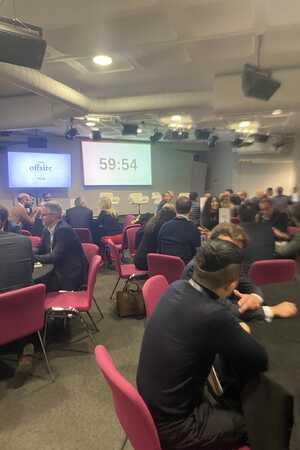
A conference is one of those rare occasions where the whole team is all under the same roof: leadership, teams, partners, sometimes customers.
Strange, then, that the default format for such a far-reaching event is still broadcast instead of participation.
Participation changes how information is received – creating ownership, recall, and stories that people will share amongst themselves later without prompting.
Why “engagement” is the wrong success metric
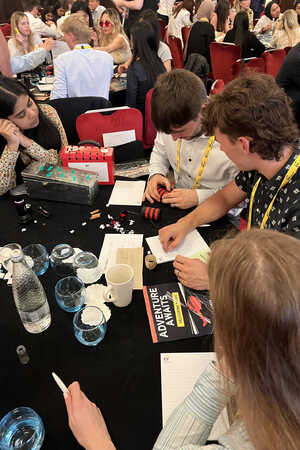
Most conference engagement metrics are soft:
→ “They seemed energised”
→ “The room felt good”
→ “The feedback was positive”
The real question should be:
Did the message land in a way people could use?
If your conference moment can be swapped out for a different activity and nothing changes, it wasn’t doing anything. It was filler.
The three structural failures of passive conferences
1) No stakes
If nothing is at stake, there’s no reason to commit. Passive formats are safe by design. You can half-listen and lose nothing. In the real world, the best work happens when there are constraints in place.
2) No roles
In most conferences, the audience is anonymous. You’re either a listener or a question-asker. That’s it.
Roles create responsibility. Responsibility creates attention.
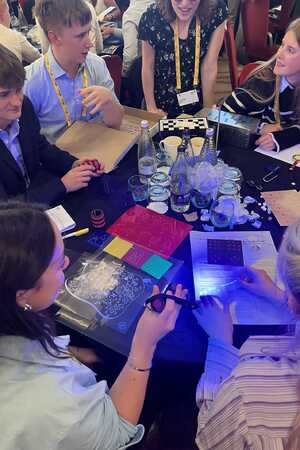
When someone has a mission, a time limit, and teammates depending on them, attention stops being a request and becomes a requirement.
3) No consequence
If nothing changes after the session, the session doesn’t matter.
Most conference content ends when the slide changes. There’s no moment where the message is tested, used, built, or proven. Which means it doesn’t become part of the delegate’s personal experience of the day.
And people remember experience.
That’s why Challenger builds around immersion, narrative, collaboration and consequence.
The replacement model: Experiential Conference Design
Call it experiential design, immersive communication, story-led challenges – the label matters less than the simple mechanism:
Brief: mission + constraint
What must teams achieve – and what are they not allowed to do?
This is where your content starts to transform. Instead of “Here are our values”, it becomes:
“Build the values under time pressure, with limited information, as a team.”
Pressure: time + uncertainty + trade-offs
Create conditions in which it pays to hold attention under pressure: a clock, competing priorities, incomplete information. That’s how real decisions feel. Pressure reveals what people do, not what they say they do.
Reveal: content becomes action
Instead of asking delegates to remember your message, you put the message inside the challenge.
-
That blog article no-one read becomes a newspaper front page with a coded story.
-
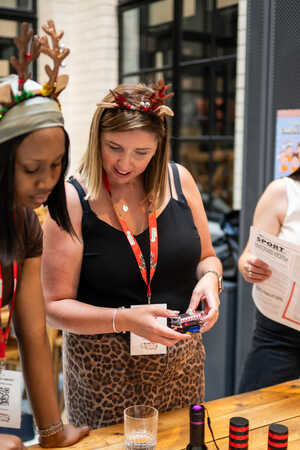
The “critical values” slide becomes a bespoke 3D build teams physically assemble.
-
The strategy becomes a case file: evidence, contradictions, signals to spot.
Now your content isn’t just being “delivered”.
Debrief: make it connect to Monday
A debrief is where the facilitator can pull the thread back to the point:
-
What did you do under constraint?
-
Where did you miscommunicate?
-
What did you prioritise?
-
What did you ignore – and why?
The goal is to make the message feel unavoidable.
What this looks like at 100+ scale
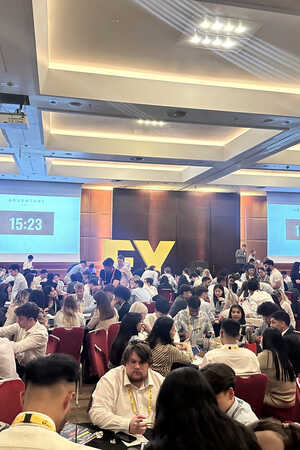
The most common objection is scale: “Can this work for 100+ people?”
Yes – when it’s designed for throughput from the start.
Conference experiences are modular, repeatable formats that run in parallel with facilitation built in. They’re made to sit inside a programme without derailing it.
That’s also why we don’t treat them as off-the-shelf “escape games”. The content is bespoke. The narrative is yours. The mechanics exist to carry the message.
Who this is for (and who it isn’t)
This is for you if:
✓ You’re running a conference where the message genuinely matters
✓ You have 100+ delegates and want a shared moment that anchors the day
✓ You’re tired of passive sessions where attention depends on coffee and charisma
✓ You want a partner who can take your content and re-engineer it into an end-to-end experience
This isn’t for you if:
× You want a generic icebreaker to “bring the energy up”
× You’re looking for something that can be swapped in at the last minute
× You want a cheap activity that has nothing to do with the agenda
The point
Your conference is one of the few chances you have to make people do something together that embodies the message.
If nothing is at stake, nothing sticks.
So stop designing for receivership.
Design for participation.
If you want us to pressure-test your agenda and identify a single “anchor moment” that will make the message land, brief us with: event date, location, delegate count, and the one message that cannot be missed.
 Updating page...